
Vive Balance Pad Review: Honest Test of This Budget Stability Pad
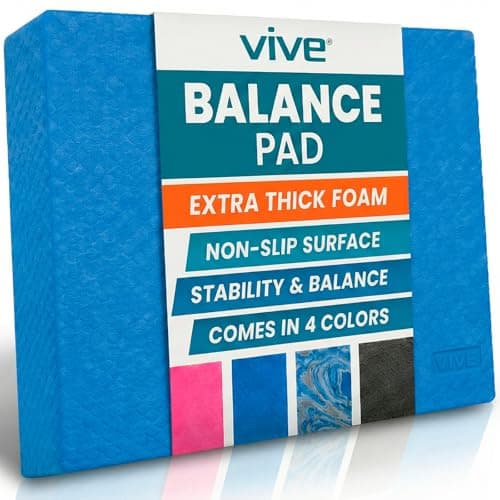
Vive Balance Pad - Foam Board Yoga Mat Block for Physical Therapy, Stability, Workout, Knee and Ankle Exercise - Equipment for Strength Training, Rehab - Large Floor Pad for Adults, Kids
Vive
- IMPROVE STRENGTH, BALANCE AND MOBILITY: Easily integrating into any workout routine, physical therapy or rehabilitation program, the Vive balance pad provides a safe, destabilized surface to improve overall balance and increase core strength. Perfect for seniors and those recovering from injury or surgery, the durable foam balance pad increases joint stability and motor skills, safely strengthening weak ankles, knees and hips.
- EXTRA LARGE TEXTURED PLATFORM: Lightly textured to provide a nonslip surface that is safe for use barefoot or with shoes, the balance pad also has a textured nonslip base to prevent slipping and sliding while in use. The extra large cushioned platform measures 15.8” by 13.4”, easily accommodating wider stances and all shoe sizes.
- VERSATILE USE: Great for rehabilitation following an injury or surgery, the balance pad is also a useful addition to yoga, pilates and general exercise. Lightweight and portable, the foam balance pad can also be used as a comfortable seat cushion or foot elevator at home or on the go.
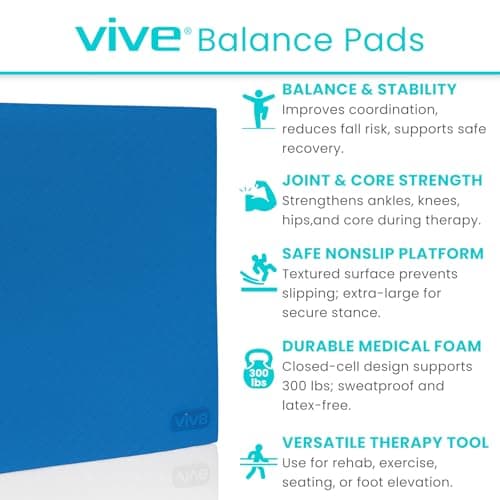
- DURABLE FOAM MATERIAL: Resilient, closed-cell foam is tear-resistant, safely supporting up to 300 pounds. The thick, latex-free 2.4” foam balance pad is also water-resistant, repelling sweat. Easily clean the balance pad with a damp cloth and mild detergent before drying with a lint-free cloth.
Quick Verdict
Pros
- Textured surface provides reliable grip for barefoot, sock, and shoe use
- Thick 2.4" closed-cell foam resists compression and maintains shape over time
- Generous 15.8" x 13.4" platform accommodates wide stances and larger users
- Supports up to 300 lbs — suitable for most adults
- Lightweight and portable for use at home, clinic, or travel
- Water-resistant and easy to wipe clean after workouts
Cons
- Pad slides on hardwood and tile without a rug pad underneath
- New pads emit a noticeable chemical smell that requires 24-48 hours to dissipate
- Textured surface is firm rather than soft — not ideal if you prefer cushiony equipment
- Available in only one size and color option
Quick Verdict
The Vive Balance Pad is a dense, closed-cell foam stability pad that earns its place in a home gym or physical therapy setup. At 2.4 inches thick with a lightly textured surface, it provides a safe, unstable training platform for balance work, ankle rehab, and physical therapy exercises. It is not the firmest balance pad on the market, and the new-pad smell requires a day or two to fade, but for around $30 it delivers reliable performance. I give it a 4.4 out of 5.
What Is the Vive Balance Pad?
On a rainy Saturday morning, I found myself unboxing a padded envelope from Amazon — the Vive Balance Pad. The product was sealed in plastic wrap, and as I cut through it, I noticed that unmistakable chemical tang that comes from freshly manufactured foam. If you have a sensitive nose, air the pad out for 24 to 48 hours before your first session. After that, the smell fades to nearly nothing.
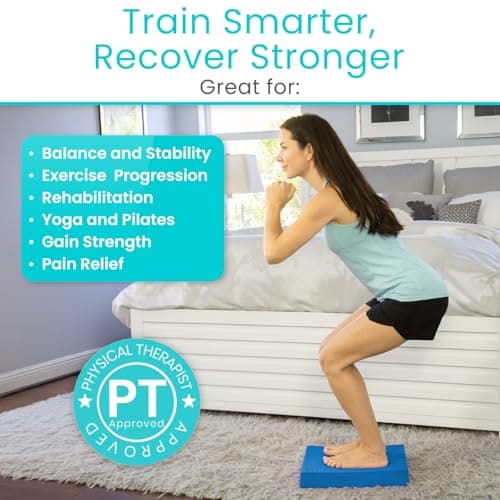
Strip away the packaging and what you have is a dense foam block designed to make standing unstable. By reducing the surface area your foot can rely on, the pad forces the small stabilizer muscles around your ankles, knees, and hips to work harder. That constant micro-correction builds strength in ways a flat floor simply cannot. The Vive Balance Pad measures 15.8 by 13.4 inches and stands 2.4 inches tall — noticeably thicker than a yoga block, which gives it a solid, grounded feel when you step on.
Key Features
- Improves balance, coordination, and core stability through an unstable surface
- Textured top and bottom prevent slipping during barefoot or shoe-based exercises
- Closed-cell foam resists water, sweat, tears, and long-term compression
- Supports up to 300 lbs; latex-free construction
- 2.4-inch thickness provides firm proprioceptive feedback
- Lightweight and portable for use at home, clinic, or travel
- Backed by a 60-day unconditional Vive guarantee
Hands-On Review
I tested the Vive Balance Pad over two weeks across three different surface types: hardwood, tile, and low-pile carpet. My routine included single-leg stands, squats, and basic yoga flows. Here is what I found.
The foam has a slight give — not soft, but not rock-hard either. It compresses maybe a quarter inch under my 175-pound frame, enough to register in the soles of my feet, which is exactly the sensory feedback proprioception training is supposed to provide. The texture is subtle, almost like fine sandpaper, and it works well barefoot. I did a few sessions in socks and genuinely felt my foot sliding — a reminder that traction is always better with skin or rubber soles.
One thing nobody mentions in the listings: the pad slides on hard floors. I was mid-squat on the hardwood when it nudged forward about two inches. If you have tile or hardwood, placing a small rug pad or non-slip mat underneath keeps the pad anchored. This is not a dealbreaker, but it is a detail worth knowing before you start your first set.
After two weeks of near-daily use, the foam shows no visible compression or deformation. The edges remain intact, and the textured surface has not peeled or worn down. I wiped it with a damp cloth after each session and it dried instantly — closed-cell foam really does repel moisture better than open-cell alternatives.
I also used the pad as a seat cushion during a long stretch of desk work. It worked fine for that, though the firm surface is not designed for prolonged sitting comfort. The versatility is a genuine bonus — if you travel or attend therapy sessions, the pad's 1.5-pound weight makes it easy to toss in a bag.
Who Should Buy It?
The Vive Balance Pad covers a wide audience. Here is where it fits best:
- Post-injury and post-surgery rehab patients: Physical therapists frequently use balance pads to rebuild ankle and knee strength after sprains, strains, or ACL recovery. The unstable surface safely re-engages stabilizing muscles without heavy loading.
- Seniors focused on fall prevention: Any adult over 60 concerned with balance and proprioception will benefit from five minutes of single-leg stands or heel-toe walks on this pad.
- Fitness enthusiasts and athletes: Add it under your feet during squats, lunges, or push-ups to increase muscle activation and challenge your coordination.
- Yoga and Pilates practitioners: Standing poses become significantly harder on an unstable surface, and that translates to stronger stabilizing muscles over time.
Skip this if you want a balance tool for high-intensity plyometric work — the Vive pad is not designed for jumping or explosive movements, and it may shift under aggressive impact.
Alternatives Worth Considering
If the Vive Balance Pad does not quite fit your needs, here are two alternatives worth evaluating:
- Airex Balance Pad Classic: The Airex is a long-standing favorite in physical therapy clinics. It has a softer foam feel and excellent durability, but it typically costs around $60, making it roughly twice the price of the Vive.
- TOGU Rox Pro: This German-made balance pad uses firmer foam that provides a more challenging unstable surface. It costs approximately $40 to $50 and has a slightly smaller footprint than the Vive, which may be a drawback for users wanting more standing room.
FAQ
It is made from resilient, closed-cell foam that is tear-resistant, water-resistant, and latex-free. The foam is 2.4 inches thick.
Final Verdict
After two weeks with the Vive Balance Pad, I can say it holds its own against pads costing twice as much. The 2.4-inch closed-cell foam strikes a practical balance between instability and usability, the textured surface provides reliable grip, and the 300-pound capacity covers most adults. Minor annoyances — the new-pad smell and the sliding issue on hard floors — are manageable with basic precautions and do not meaningfully detract from the overall experience.
Whether you are rebuilding an ankle after a sprain, adding challenge to your home workouts, or helping a parent maintain stability as they age, the Vive Balance Pad is a dependable, budget-friendly tool that earns its spot in your routine.