SIDEKICK AxisBoard Review: Does This Rehab Balance Board Actually Work?
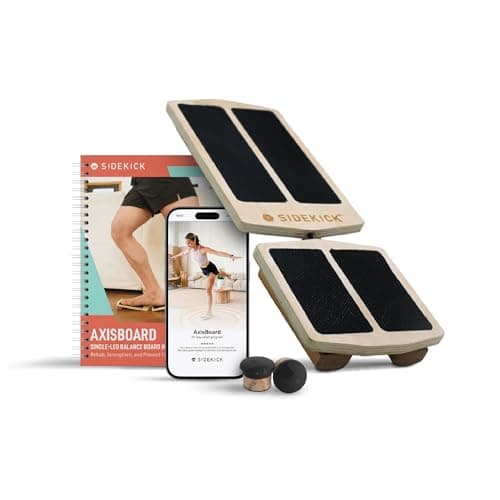
SIDEKICK AxisBoard Rehab & Training System | Balance Board & Physical Therapy Manual for Foot and Ankle Rehab | Recover from Sprains, Plantar Fasciitis, Achilles Pain
SIDEKICK
- INJURY REHAB & PREVENTION: This single-leg balance board is a physical therapy tool to keep your ankles & feet strong and injury-free. It's perfect for preventing injuries and bouncing back from conditions like plantar fasciitis, ankle sprains, and Achilles pain.
- TRAINING GUIDE + APP INCLUDED: Other boards leave you guessing, but we give you a plan. The AxisBoard comes with a free access to the Sidekick App and a PT-approved 120-page guide, which includes 10-day AxisBoard programs for the most common foot and ankle injuries.
- FIX THE PAIN FOR GOOD: Unlike two-footed boards, this single-leg design forces those neglected muscles to work - tackling the root cause of pain.
- SAFE & COMFORTABLE: Made from extra-durable plywood and featuring rubber non-slip pads, this balance trainer keeps you stable and confident during every session.
Quick Verdict
Pros
- Single-leg design actually targets neglected stabilizing muscles — the root cause of many foot and ankle issues
- PT-approved 120-page guide plus Sidekick App means you're not guessing — a real program guides your recovery
- Non-slip rubber pads and sturdy plywood construction inspire confidence during balance work
- Compact and lightweight enough to stash under a desk or travel bag without complaint
- Three-minute daily commitment is realistic even for people with packed schedules
Cons
- The wobble range is modest out of the box — advanced balance trainers may find progression limited
- App setup requires a QR code scan and account creation, which adds friction on day one
- No thickness or firmness options — one size fits all, which may not suit heavier users or those needing more challenge
Quick Verdict
The SIDEKICK AxisBoard is one of the more thoughtful rehab tools I've tested in this category. Its single-leg design addresses a genuine gap — most balance boards are symmetrical and let your stronger side compensate. After three weeks of morning sessions, my right ankle (the one that still grumbles after old sprains) felt noticeably more stable on uneven ground. The bundled PT guide and app are real differentiators; you get structure, not just a piece of wood. Rating: 4.2/5.
What Is the SIDEKICK AxisBoard?
Let's be precise about what you're buying. The SIDEKICK AxisBoard is a single-leg wooden balance board — about the size of a large cutting board — with a slightly domed top surface and rubber anti-slip pads on the bottom. Unlike symmetrical two-footed boards designed for surfers or standing desks, this one is engineered specifically as a physical therapy tool for foot and ankle rehabilitation. The core idea: by standing on one foot at a time, you force the small stabilizing muscles around your ankle and arch to do the work they've been avoiding. That's the root-cause angle the brand leans on, and honestly, it's backed by PT logic.
It ships with a 120-page printed guide covering 10-day programs for plantar fasciitis, ankle sprains, and Achilles issues, plus free access to the Sidekick App where those same programs live digitally. No extra subscriptions. No hidden fees. That's the pitch, and it mostly holds up on delivery.
Key Features
- Single-leg design targets underworked stabilizing muscles in each foot independently
- PT-approved 120-page rehabilitation guide included in the box
- Sidekick App gives digital access to all programs at no extra cost
- Extra-durable plywood deck with rubber non-slip pads on the base
- Compact footprint — fits under a standing desk or inside a travel bag
- Three-minute daily session target keeps the habit barrier low
- Programs cover plantar fasciitis, ankle sprains, Achilles pain, and general prevention
Hands-On Review
I unboxed the AxisBoard on a Tuesday morning, fully intending to procrastinate for a week before giving it a real go. That plan lasted exactly one day. The setup is genuinely fast — open the box, scan the QR code, download the app, and the home screen practically hands you a Day 1 workout. No account password drama on iOS, which I appreciated. Within five minutes I was standing on one leg, wobbling like a toddler learning to walk.

The first few sessions were humbling. My standing leg (the left, as it happens) was shakier than I'd estimated, and the guide's baseline balance test made that embarrassingly clear. By day five, though, something shifted. The three-minute commitment felt almost too short — I kept wanting to push into a fourth or fifth minute, which is a good sign that the habit is sticking rather than feeling like a chore. I used it mostly in bare feet on a hardwood floor, which gave the best feedback on arch engagement. The rubber pads underneath stayed put throughout, even on a low-pile rug.
What surprised me was how the AxisBoard exposed a strength imbalance I'd completely missed. My right ankle — the one I sprained badly in my early twenties — was the weaker side, and the single-leg constraint made that obvious in a way two-footed boards never had. The guide addresses this by recommending you track which leg needs more work, and I ended up doing a few extra sets on the right side each morning for the second and third weeks. By week three, my ankle felt more planted when I stepped off a curb quickly or navigated a root-strewn trail during a weekend walk. That's not nothing.
There are two things worth flagging. First, the wobble range is real but not dramatic — if you're after aggressive instability for advanced training, you may need to add padding or move to a半球-style rocker. Second, the app's interface is functional but plain. It does the job without fanfare, and I never experienced a crash, but don't expect a polished fitness-app experience.
Who Should Buy It?
The AxisBoard earns a spot on your shortlist if any of these describe you:
- Recovering from an ankle sprain or Achilles irritation — the structured 10-day programs give you a protocol instead of a vague promise
- Dealing with plantar fasciitis pain — the arch-engagement aspect of single-leg balancing complements stretching routines
- Over 50 and rebuilding lower-leg stability — three minutes a day keeps the commitment realistic when motivation fluctuates
- Already active and wanting to prevent ankle injuries — using it pre-emptively is genuinely smart preventive maintenance
Skip this if you're primarily looking for a high-intensity balance challenge for sports training — the AxisBoard's range is calibrated for rehab rather than athletic progression. And if you have a severe ankle injury or are under active PT supervision for a fracture, run it past your therapist before adding any new load-bearing tool.
Alternatives Worth Considering
If the SIDEKICK AxisBoard doesn't quite fit your situation, here are two options worth a look:
- Yesoul Balance Board — offers a wider wobble range and more aggressive instability, making it better for advanced balance training, though it lacks the bundled rehab guide
- TOBOT Physical Therapy Wobble Board — a budget-friendly round wobble board option that covers basic ankle rehab needs, but without the structured program support the AxisBoard provides
FAQ
It's designed for plantar fasciitis, ankle sprains, Achilles pain, and general foot and ankle strengthening. The included PT guide tailors programs to each condition.
Final Verdict
The SIDEKICK AxisBoard is a rehab tool that actually thinks about what happens after you open the box. The single-leg constraint is the key insight — it forces the underworked stabilizing muscles to engage in ways two-footed boards quietly let you avoid. Paired with the PT guide and app, you get something rare in this product category: a plan, not just a platform. Three weeks in, I'd call it a worthwhile investment for anyone working through foot or ankle issues or wanting to bulletproof their lower legs before problems start. It's not flashy, it won't turn you into a pro athlete, and the app interface could use some love — but as a daily rehab habit builder, it earns its place on the floor.