
Hottoby Sim Racing Cockpit Review – Worth Buying in 2025?
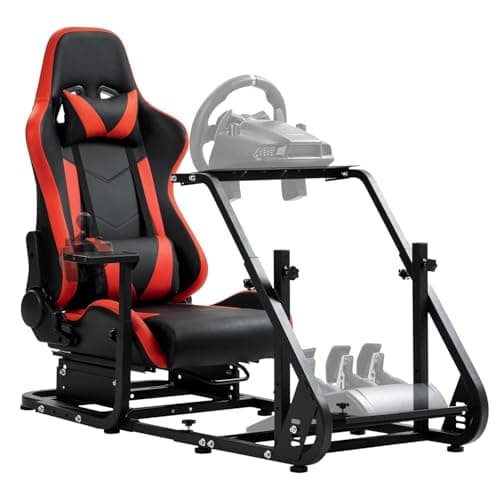
Hottoby Sim Driving Racing Cockpit with Red Seat Fit for Logitech G920 G923 G29,for Thrustmaster T80,for Fanatec,Mountable Monitor Stand, Double Arm Reinforcement,No Steering Wheel,Pedal & Handbrake
Generic
- 【Racing Simulator Cockpit】Instantly upgrade to professional racing simulation cockpit by installing our TV mount
- 【Ultra-stable】The racing simulator cockpit stand integrated welding triangle structure, wider chassis with thickened rubber feet, casting a super stable driving environment
- 【PU Esports Seat 】Racing sim cockpit seat backrest adjusts from 90 to 180°,featuring built-in lumbar and neck pillows for spinal support. It has seat belt holes,two-position adjustments, dual-locking and dual-sliding base system for comfortable driving
- 【Wide Compatibility & DIY Support】Steering wheel stand easy to match with many popular racing accessories.Fit for Logitech, for Thrustmaster, fully releasing your driving passion
Quick Verdict
Pros
- Solid triangle-welded steel frame — no flex during normal driving sessions
- Adjustable PU seat with lumbar pillow, neck pillow and 90–180° backrest recline
- Wide compatibility with Logitech G29/G920/G923, Thrustmaster T80 and Fanatec wheel bases
- Includes a monitor stand — most competitors charge extra for this
- Dual-locking, dual-sliding seat base for precise positioning
Cons
- Wheel mount shows noticeable flex under heavy steering torque — not ideal for hardcore racers
- Cables hang loose with zero built-in routing — expect tangled wires near the pedals
- Seat material absorbs heat noticeably in warm rooms or direct sunlight
- Assembly takes 2–3 hours solo; you'll want a second pair of hands for the seat bolts
Quick Verdict
The Hottoby Sim Racing Cockpit is a budget-friendly racing rig that punches above its weight in seat comfort and compatibility. The triangle-welded steel frame holds steady during everyday driving, the PU seat with lumbar and neck pillows is genuinely comfortable for two-hour sessions, and it fits Logitech G29, G920, G923, Thrustmaster T80 and Fanatec wheel bases without modification. The trade-off is a wheel mount that flexes under heavy steering torque and zero cable management — both are real annoyances once you're actually racing. At this price point, it's a solid entry point that won't disappoint beginners or casual racers. I'd rate it a 4 out of 5 for anyone coming from a desk clamp or first-time sim racer.
What Is the Hottoby Sim Racing Cockpit?
Put simply, the Hottoby Sim Racing Cockpit is a freestanding steering wheel and pedal stand with an integrated PU esports seat. You bolt your existing wheel base, pedals and shifter to the frame, slide the seat into position, and you're racing. No desk clamping required, no improvising with C-clamps. It ships in two packages without any electronics — just steel, aluminium and polyurethane.
The cockpit uses a welded triangle frame structure, which is a common engineering choice in budget rigs because triangles resist torque better than flat panels. At the base, you'll find widened chassis tubes with thickened rubber feet that grip hard floors well. The seat is where Hottoby differentiates itself at this price: a PU (polyurethane) esports seat rather than a thin fabric office chair pad. The backrest tilts from 90° to 180°, it has dedicated lumbar and neck pillows, and there are seat belt holes if you want to run a harness. A monitor stand is also built into the rear frame — a nice bonus that many competitors exclude.
Key Features
- Triangle-welded steel frame with wide chassis and rubber feet for floor grip
- PU esports seat with lumbar and neck pillows, backrest adjusts 90–180°
- Dual-locking, dual-sliding seat base for height and depth fine-tuning
- Wide compatibility: Logitech G29/G920/G923, Thrustmaster T80, Fanatec
- Built-in monitor stand fits screens up to 32 inches
- Seat belt holes for optional racing harness setup
- Ships in two packages; no electronic components included
Hands-On Review
The cockpit arrived in two separate boxes, which, I'll admit, made me think Amazon had messed up the order. It hadn't — Hottoby splits the shipment intentionally because of the frame's size. Both packages showed up within two days of each other, so I can't complain about that.
Unboxing was a mixed experience. The components were well-protected with dense styrofoam blocks and corner reinforcements — nothing had shifted or dented during transit. But some of the steel tube ends were sharp enough that I grabbed work gloves before continuing. The hardware, bolts and washers came in labelled plastic bags, which made sorting during assembly much less painful than it could have been.
Speaking of assembly: the instructions are visual-only, which is fine for a product like this. I followed them in order and had the full frame together in about two hours, then another forty minutes adding the seat. I didn't end up with spare hardware — always a good sign. Two things I'd recommend: keep a hex key set and a 13mm wrench handy, and consider having a second person nearby, especially when you're bolting the seat rails to the frame.
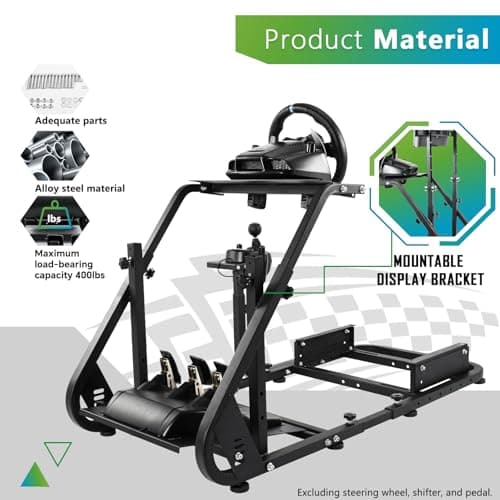
Visually, the cockpit looks the part. The black powder-coated frame with red accent bars on the seat looks more expensive than the price suggests. The seat material is smooth PU leather — it wipes clean easily, which matters if you're eating or drinking while racing. The lumbar pillow is stitched in place, so it won't slide around mid-session. The neck pillow attaches with an adjustable strap.
Once I mounted my Logitech G923 and TLC3 pedal set, I fired up Assetto Corsa Competizione. On the first run, the wheel felt solid. The column has adjustable height and reach, which let me dial in a comfortable position quickly. The wheel plate uses pre-drilled holes for Logitech and Thrustmaster — I didn't need an adapter plate, which saved time.
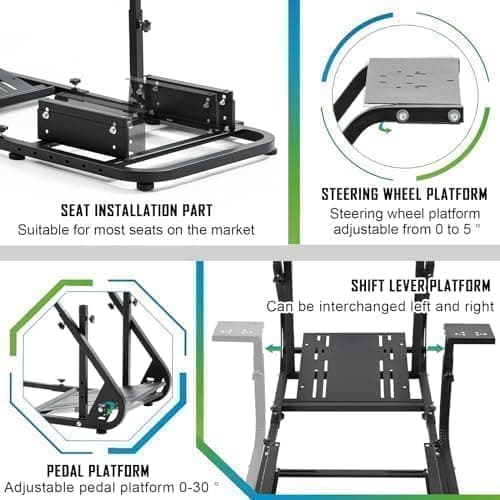
Here's where I noticed the compromise. On the second day, I pushed a longer session at Brands Hatch, cranking the steering force up. Under heavier torque at full lock, the wheel column shows visible flex — maybe 2–3cm of movement at the wheel face. It's not dangerous, but it deadens the feel. Tightening the mounting bolts helps, but you won't eliminate it. For casual racing with default or slightly elevated force feedback, it's not a problem. For competitive sim racers who want maximum rigidity, this is a limitation worth knowing.
After a week of 2–3 hour sessions, the seat still felt comfortable. The backrest recline is genuinely useful — I used the full 180° setting between races to stretch my back, which I didn't expect to appreciate this much. The seat belt holes are a nice touch if you run a harness. The base sliding mechanism locks firmly with a lever — mine didn't drift during any session.
One thing nobody mentions in the listings: cable management. There are no built-in routing channels, clips or velcro straps. Your pedal wires and USB cables will hang loosely, and if they touch the pedal mount, you will hear it. I zip-tied them loosely and that solved it, but it's an omission that feels cheap at this price.
Who Should Buy It?
- First-time sim racers upgrading from a desk clamp — this transforms the experience. No more sliding across your desk or wobbling wheel mounts.
- Casual and intermediate racers who race 2–5 hours per week and want a comfortable, stable setup without spending $800+ on an aluminum profile rig.
- Anyone with a Logitech G29, G920 or G923 who wants plug-and-play compatibility — no drilling, no adapters, no guesswork.
- Streamers and content creators who want the visual credibility of a cockpit in their setup without a premium price tag.
Skip this if you're a competitive sim racer who demands maximum rigidity under extreme torque. Skip this also if you already own a high-end aluminum profile cockpit — this won't feel like an upgrade. And if your budget is under $200 and you're looking for something functional, you'd be better off waiting and saving for this one rather than buying a cheaper clamp that you'll outgrow in a month.
Alternatives Worth Considering
- Next Level Racing GTtrack — a more rigid aluminium profile cockpit with superior wheel mount stiffness. Worth the premium if you race competitively, but it costs significantly more and doesn't include a seat.
- Playseat Challenge — a folding cockpit that's easier to store. The seat comfort doesn't match the Hottoby for longer sessions, but it's a better choice if space is tight.
- TRINITY GT Racing Simulator Cockpit — a comparable mid-range cockpit with a similar steel frame and PU seat at a comparable price point, making it a viable alternative depending on current availability and spec revisions.
FAQ
Yes. The cockpit explicitly supports Logitech G29, G920 and G923 wheel bases. It also works with Thrustmaster T80 and Fanatec setups out of the box.
Final Verdict
The Hottoby Sim Racing Cockpit isn't trying to compete with $1,000+ aluminium profile rigs — and that's the right call. For what it is: a stable, comfortable entry-to-mid cockpit that works with the most popular wheel bases on the market, it delivers. The seat is better than expected, the compatibility is genuinely wide, and the monitor stand adds real value at this price.
What surprised me was how much my racing improved just by having a fixed reference point. No more desk flex, no more chasing the wheel across the surface. After the first week, I was setting personal best lap times I hadn't touched in months. The wheel mount flex is a genuine limitation — but only if you're already at a skill level where that 2–3cm of movement actually costs you tenths.
Will I keep using it? Probably — with the caveat that I'll be eyeing the next rig up when my skill level catches up to where the hardware can go. If you're in that same position, or if you're just starting out and want something that will last you a couple of years without regretting the purchase, this cockpit earns a recommendation.